

- One hundred attendees to the first Intercluster conference of the CEEC, the CLÚSIC and INGENIEROS BCN
- More than half of the 25 million homes in the property stock in Spain are over forty years old: a reform of the buildings is necessary to achieve correct energy efficiency: the facades are essential to meet this challenge.
- We cannot ignore fire safety in this type of intervention: Grenfell Tower in London, Torre del Moro in Milan, New Hotel and Torre Ámbar in Madrid remind us of the virulence of fires in this type of accident.
Last Wednesday, October 20, 2021, the Cluster of Efficient Energy of Catalonia (CEEC), the Cluster of Security Against Fires (CLUSIC) and the College of Graduates and Industrial Technical Engineers of Barcelona (ENGINYERSBCN) will organize the first day Intercluster to delve into the subject of building rehabilitation and the risk of fire on the façade. A day that generated great interest and welcomed a hundred people between face-to-face and online attendees.
Marta Martí, manager of INGENIEROS BCN; Esther Izquierdo, president of the CECC; and Elías López, president of CLÚSIC, agreed on the need and opportunity to hold this type of conference to provide cross-cutting and wide-ranging views that allow us to make more accurate decisions and investments.
Energy efficiency and fire safety are sectors that have to go hand in hand. Both are intrinsically linked to the building. In this sense, the arrival of European funds that will serve to rehabilitate buildings, which are very old in Spain, will serve to improve the energy efficiency of half a million homes between now and 2023. It is essential that this improvement of our homes also results in an improvement of fire safety in our homes.
The intervention in facades is key so that the comfort and energy savings of our buildings improve, however, the facades collect many of the ingredients (unlimited oxygen, verticality ...) so that fires can spread quickly and violently . It is necessary to intervene energetically in the facades, but it must be done ensuring the safety of the occupants of the buildings.
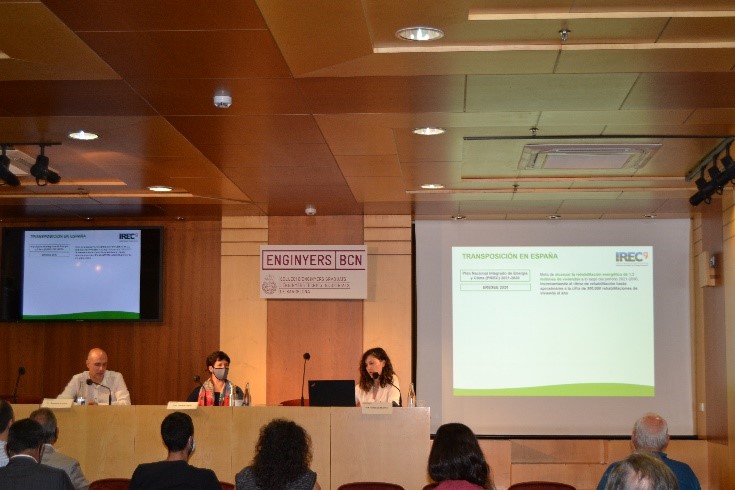
Thus, the intervention of Ainhoa Mata from the Catalan Energy Institute (ICAEN) focused his intervention on presenting how the Next Generation EU aid will be distributed in Catalonia and Spain (140,000 million euros throughout the State) and the various lines of aid associated with the energy renovation of buildings
Soledad Ibáñez from the Energy Research Institute of Catalonia (IREC) explained the situation of the building stock in Catalonia, highlighting that 93% of buildings in Spain are prior to 2007 (therefore, prior to the Technical Building Code) and , of these, 56% prior to the first technical standard of 1980. There is a reform of the buildings to achieve more efficient energy ratings and more effective fire safety interventions.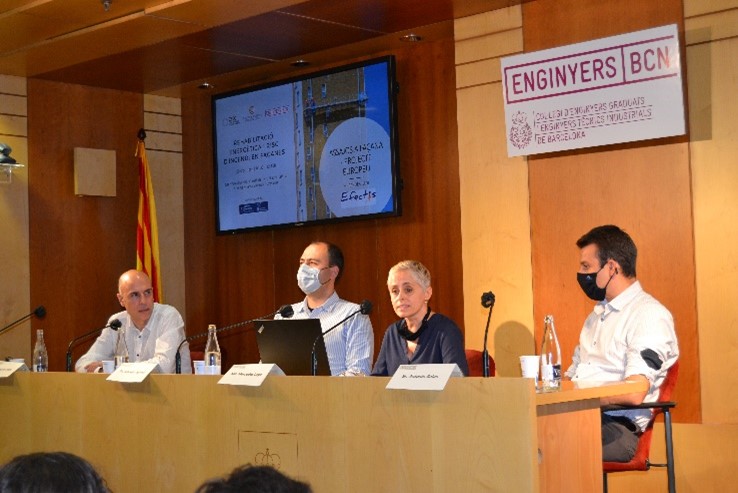
Antonio Galan de Kingspan focused attention on the reality of the fires that spread across the façade, giving examples of the spectacularity and dangerousness of this type of incident. The spread of fire on the façade is considered one of the fastest ways of spreading the fire in a building. Antonio also showed the current basic normative requirements of reaction to fire of the construction systems and of insulation of the facades. These types of fires are very complex and we need a lot of science to make decisions about what materials and systems are the most suitable for our buildings.
In this sense, the results of the reaction to fire tests on the facade are fundamental. Salvador Suñol from Applus + brought us closer to the current wide range of test regulations (12 test methods in Europe) with great methodological differences. The intervention of Mercedes Lago de Efectivo focused precisely on the European project to harmonize the large-scale reaction to fire tests on the façade that is being developed with the participation of several European countries and that will provide a common and consensual framework of work .
Finally, the day ended with a very dynamic open speaking session, moderated by Gustavo Crespo from ARCBCN, in which both the face-to-face and online attendees were able to ask the speakers questions.
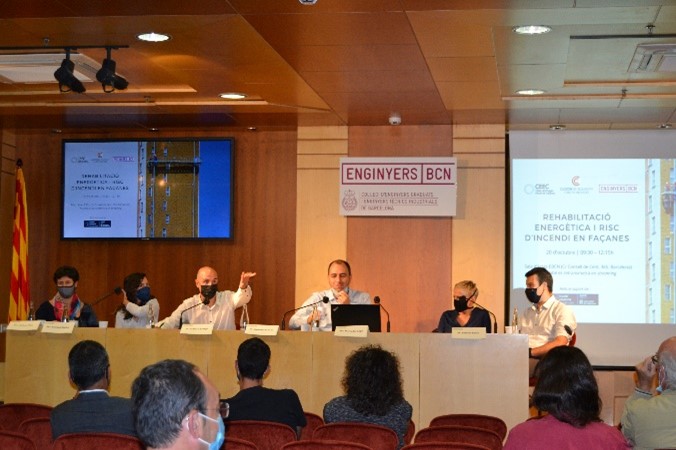
At the conclusion of the day, we could affirm that if we are able to work together, considering all the interactions, we will be able to achieve safer, more comfortable and energy-sustainable buildings. Intercluster conferences like this one make this task easier for us. We hope it will be the first of many shared sessions to delve into complex and wide-ranging topics.
You can watch the day again by clicking here.

_20231114162600.png)

