
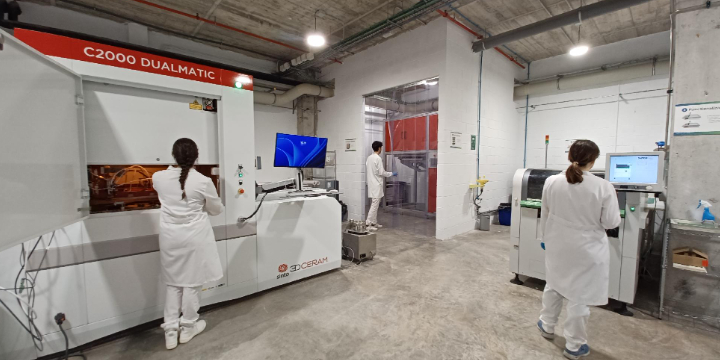
The Catalonia Institute for Energy Research (IREC) has launched a new pilot line for the manufacture of ceramic devices using 3D printing for the generation and use of renewable hydrogen. This manufacturing process is disruptive and unprecedented worldwide. The achievement positions IREC as a global pioneer in this field and represents a strategic advance for the production of hydrogen technologies in Catalonia.
This pilot line, presented under the name Merce Lab (Manufacturing Energy Ceramic Devices), was installed thanks to funding from the company H2B2 as part of the Tecnopropia project, among other initiatives. It will manufacture solid oxide cells (SOCs) for fuel cells and electrolyzers at a pre-industrial scale.
Currently, very few actors worldwide are capable of producing this type of cell, which stand out for their high efficiency, superior to that of other technologies. Thanks to 3D printing of functional ceramics, Merce Lab becomes the first laboratory in the world to use this method to produce SOCs.
The main advantage of 3D printing is that it allows more flexible designs, lower material consumption, and a drastic reduction in the weight and volume of the final device, thereby increasing the energy density of the resulting systems. This improvement makes these devices particularly attractive for both transport and renewable energy storage through hydrogen generation.
This is a highly innovative and scalable technology, structured in several stages, from the preparation of basic components to the stacking of cells and their validation. This structure will facilitate technology transfer to national and international companies and support the creation of new business models aimed at accelerating the industrialisation of renewable hydrogen.
According to Marc Torrell, head of Merce Lab at IREC, “This facility positions us as pioneers in SOC technology manufacturing on a global scale,” adding that “it represents a disruptive step in manufacturing processes and the performance of ceramic-based devices, opening the door to the development of new SOC systems for applications that could not previously meet the required specifications, such as maritime or air transport.”
This initiative is part of an Important Project of Common European Interest (IPCEI) called Tecnopropia (~€25 million), led and co-financed by the electrolyser company H2B2 and supported by Next Generation funds from the PRTR. The laboratory is complemented by funding from ongoing international projects at IREC, such as CLEANHYPRO, HYP3D, COMECOCO2, and H2SHIFT. The initial investment planned for this pilot line is €2 million.
IREC has already manufactured the first complete devices in this laboratory, and strategic collaborations are being established with companies in the sector, ranging from large corporations (H2B2, 3Dceram, AMES, Viver Clean Tech) to smaller enterprises (AESA, Nano4Energy, M-reformer), with the goal of accelerating the development and commercialisation of this technology. This initiative will not only facilitate the entry of hydrogen into the national market but will also help democratise access to cleaner and more sustainable energy technologies.
The development of this pilot line responds to the growing volume of investment in infrastructure for the deployment of the hydrogen economy. In this context, IREC plans to create Oxhyd Energy, a spin-off dedicated to the commercialisation of SOC fuel cells as a key element in the energy transition.
Key product and pilot line features
SOC technologies offer a dual advantage: they can operate both as fuel cells (using hydrogen to generate electricity) and as electrolyzers (producing hydrogen for energy storage). Based on ceramic materials and operating at high temperatures, these devices can save up to 25% of the energy required for hydrogen production, making them far more efficient than current polymer-based cells.
Merce Lab’s current manufacturing capacity is estimated at around 2 MW/year, and it is easily scalable, quadrupling the power density of final devices compared with existing commercial technologies. The estimated cost is approximately €800/kW, which could reduce the price of hydrogen to below €4/kg.
Another differentiating factor is that the materials used will be sustainable, as the modules will be free from cobalt, nickel, rare earths, and other critical raw materials. This presents a business opportunity given the projected global demand for electrolyzers and fuel cells by 2030, which is expected to reach several hundred GW—far beyond current global capacity.
This pilot line covers the entire technology value chain, structuring the process into five major blocks: i) the preparation of inks as raw material; ii) the manufacture of cells, which are the basic units of the device; iii) the production of interconnectors, key elements for system integration; iv) the stacking of components; and v) the validation of the final device to verify quality and efficiency before further use.
From the CEEC, we would like to highlight the coverage this news item has received across different media outlets and, therefore, share some of the impacts it has generated.
We would like to highlight the coverage this news item has received across different media outlets and, therefore, share some of the impacts it has generated.
- https://www.viaempresa.cat/innovacio/irec-impulsa-pionera-linia-impressio-3d-components-generar-hidrogen-renovable_2226691_102.html
- https://beteve.cat/economia/irec-fabrica-dispositiu-generacio-hidrogen-renovable-unic-mon/
- https://www.leconomic.cat/article/2608533-l-irec-innova-en-tecnologia-de-l-hidrogen-amb-merce-lab.html
- https://exteriors.gencat.cat/ca/ambits-dactuacio/afers_exteriors/ue/fons_europeus/detalls/noticia/20251204_irec-hidrogen


_20231114162600.png)

