
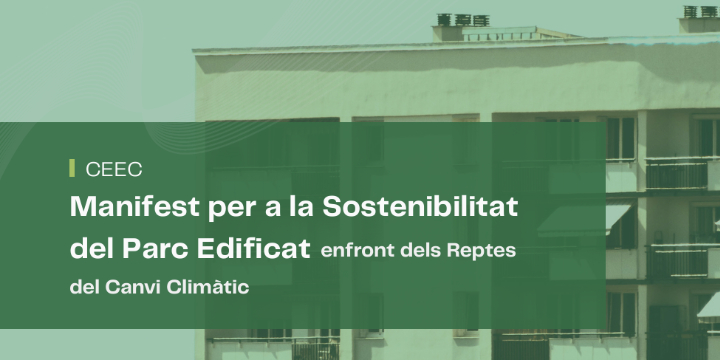
The Clúster de l’Energia Eficient de Catalunya presents the "Manifest for the Sustainability of the Built Environment in the Face of the Challenges of Climate Change – Challenges, Needs and Proposed Actions", an initiative developed jointly with the coordinators of the Cluster’s Sustainable Building Working Group,Jordi Pascual (IREC), Héctor Fernández (GP9 Consulting) and Ivan Capdevila (Wattega).
The manifesto was created with the aim of highlighting the main challenges and priority actions that our country must address to advance the sustainable transformation of the built environment, marking both internally and externally the topics that are intended to be worked on from now on. The full manifesto can be consulted via this link, and the Spanish version here.
The built environment includes almost 100,000 tertiary-use buildings
In a context of scientifically proven climate change, buildings become key spaces for protection, health and energy efficiency. However, the built environment in Catalonia, with around 3 million homes and almost 100,000 tertiary-use buildings, is largely older than modern energy efficiency standards and concentrates high consumption and social vulnerabilities.
With approximately 40% of the existing stock energy-certified, around three quarters of it have ratings of E, F and G.
Considering the background of building and renovation in Catalonia, also detailed within the initiative, and the established timelines, the manifesto proposes a decalog based on challenges, needs and proposals, in which all stakeholders are addressed.
1. Integrated territorial planning
2. Digitalisation of buildings in municipalities
3. Standardisation of metrics and data access
4. Adaptation of regional and local regulations
5. Promotion of prefabrication, industrialisation and the circular economy
6. Attraction of new talent and promotion of human resources in the building sector
7. mPromotion of technological solutions and energy flexibility within a framework of electrification
8. Monitoring and intelligent management of the built environment
9. Ongoing support for financial mechanisms and establishment of grants
10. Energy communities and one-stop shops as a means to foster a culture of sustainability in buildings and among citizens
11. Resilience and adaptation to climate change as an irreplaceable requirement
12. Establishment of active collaboration and governance
The "Manifest for the Sustainability of the Built Environment in the Face of the Challenges of Climate Change – Challenges, Needs and Proposed Actions", therefore, aims to promote the sustainability of the built environment.

_20231114162600.png)

