
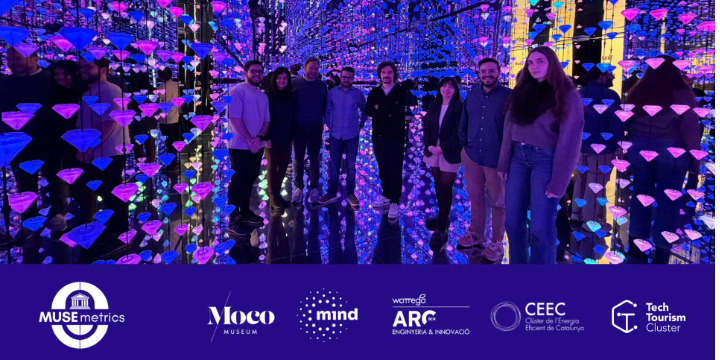
A Catalan consortium made up of the Tech Tourism Cluster (TTC), the Clúster de l’Energia Eficient de Catalunya (CEEC), the Moco Museum and the technology companies Mind and Wattega has launched MuseMetrics, a comprehensive data management platform designed to make museums more sustainable while promoting the conservation of artworks.
The project begins with a pilot at Moco Museum Barcelona, the Museum of Modern and Contemporary Art of Barcelona, in a context of growing pressure on museums: maintaining optimal temperature, humidity and lighting conditions, essential for protecting collections, requires intensive energy use. MuseMetrics uses real-time analytics and artificial intelligence to optimise climate control and lighting, anticipate visitor peaks and improve the on-site experience.
The aim is to act on three key areas. Firstly, improving energy efficiency —with potential reductions of up to 35% according to international benchmarks—. Secondly, strengthening preventive conservation by avoiding fluctuations that can cause anything from cracks to chemical degradation in artworks; and finally, improving the visitor experience by reducing overcrowding and enabling smoother flows in spaces that can reach up to 25 million visits annually in Catalonia alone.
From data accumulation to real-time decision-making
One of the sector’s main challenges is not a lack of information, but its fragmentation: data on energy consumption, environmental conditions or visitor flows is often scattered across different systems, making efficient management difficult. MuseMetrics integrates all this information into a single platform capable of analysing it in real time and anticipating critical situations.
Through existing data sources and advanced analytics models, the system will detect temperature or humidity deviations, forecast visitor peaks and generate recommendations to optimise climate control and lighting. The incorporation of predictive models and machine learning techniques will make it possible to anticipate how events or weather conditions will affect visitor flows, supporting planning and resource adaptation before congestion occurs.
According to Francesc Ribera, Cluster Manager of CEEC, “collaboration between clusters from different sectors is key to driving high-value projects such as MuseMetrics, aimed at preserving the Moco Museum’s art collections and promoting a more sustainable and digitalised tourism model, through the integration of data linked to energy consumption and visitor flows”.
A scalable model for the cultural sector
With a duration of 11 months and a total budget of €99,155.60, partially funded by ACCIÓ (€62,275.02), the project aims to go beyond the pilot phase. Its goal is to develop a replicable solution for museums and heritage institutions both in Catalonia and in international markets. Catalonia currently has 641 museum facilities, including registered museums and other publicly accessible collections, highlighting the project’s scalability potential.
The results will be presented publicly at the Forum TuristTIC, with the ambition of positioning Catalonia as a living lab for innovation at the intersection of culture, technology and sustainability.
At a time when cultural institutions are seeking to reduce their environmental footprint without compromising their mission, intelligent data management is emerging as one of the key levers for transforming the sector.

_20231114162600.png)

