
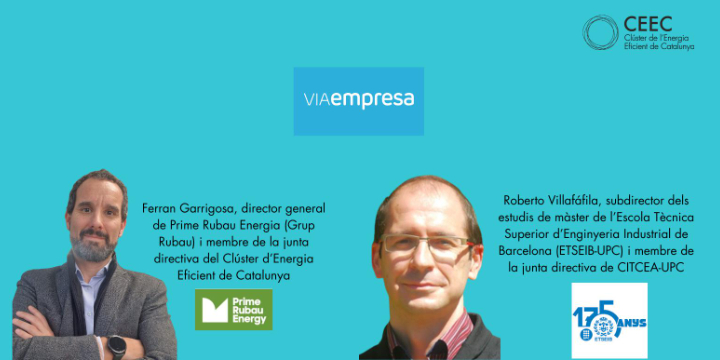
A report by VIA Empresa analyses the causes and consequences of the major power drop on 28 April 2025 and focuses on the future challenges of the energy model, through the perspectives of Ferran Garrigosa and Roberto Villafáfila.
On 28 April 2025, a voltage control failure caused a sudden drop of 15 GW in national electricity demand in just five seconds. One year later, we are sharing a report by VIA Empresa, written by journalist Marc Vilajosana, marking the first anniversary of the major blackout we experienced.
The analysis brings to the table key issues such as system weaknesses, the ability to respond to critical incidents, the role of different energy sources and the evolution of the energy model in a context of accelerated transition. In this regard, the report states: “Within this climate of uncertainty, many eyes have turned towards renewable energy, particularly wind and solar PV, the two main sources of generation in the country”.
To further explore this reflection, the report includes insights from several sector experts, including professionals linked to the Clúster de l’Energia Eficient de Catalunya (CEEC).
“Few countries are at such an advanced level of decarbonisation of electricity consumption,” says Ferran Garrigosa, CEO of Prime Rubau Energia (Grupo Rubau) and board member of the Clúster de l’Energia Eficient de Catalunya.
At the same time, attention is also drawn to the economic challenges associated with integrating key technologies such as energy storage: “Investing in batteries means increasing investment while reducing production, as a battery does not generate energy—quite the opposite. It goes completely against your profit and loss account,” he points out.
From an academic perspective, a structural shift in the way the electricity system operates is also highlighted: “The variability of renewable resources in electricity generation is changing how the system has traditionally been conceived, where power plants had a fossil or hydro source that allowed them to control generation and match demand,” explains Roberto Villafáfila, Deputy Director of Master’s Studies at the Barcelona School of Industrial Engineering (ETSEIB-UPC) and board member of CITCEA-UPC.
In this context, the expert stresses the need for system adaptation: “The blackout showed us that we must look at how to facilitate the integration of renewables into the system, and we need to be aware that this entails both evolution and transition”.
You can read the full report on VIA Empresa.


_20231114162600.png)

