
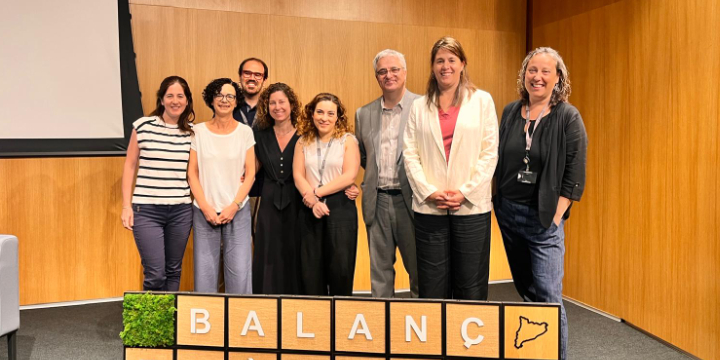
The Catalan Institute of Energy (ICAEN) presented the 2024 balance of Catalonia’s electricity system in an event that brought together representatives from across the energy sector. The session not only served to showcase the main data on electricity generation and consumption but also to spark debate and highlight the future challenges involved in advancing the decarbonisation of Catalonia’s electricity system.
During the presentation, ICAEN’s director, Anna Camp, emphasised that renewable energies accounted for 21.6% of total electricity generation, a figure 4.2 percentage points higher than the previous year and the highest of the century so far. Marta Morera, Director General for Energy, underlined the importance of having reliable data to guide decision-making, lamenting that such data is often undervalued.
Regarding overall figures, in 2024 Catalonia generated 40,481.5 GWh of electricity — the lowest volume since 2001 — with nuclear energy being the main source (56.7%), followed by renewables. Electricity consumption was slightly lower than in 2023 (down 0.5%), with a total of 40,834.0 GWh. The industrial sector led demand, accounting for 37.8%, followed by the services sector with 33.8%. Growth in photovoltaic self-consumption was also highlighted, with 24,610 new installations, bringing the total to 126,752 and a cumulative capacity of 1,381 MW.
The event featured two roundtable discussions. The first, focused on electricity producers, highlighted the wind sector’s commitment to reaching 5,000 MW by 2030, calling for faster administrative procedures. The solar sector urged that attention be given to ground-mounted installations and raised concerns about grid saturation. Representatives from the cogeneration, nuclear and small-scale hydropower sectors also voiced concerns, stressing their respective roles within the energy mix and calling for regulatory stability and institutional support.
The second roundtable brought together system stakeholders: distributors, suppliers, energy communities and aggregators. Participants pointed to challenges such as the need to adapt the grid to new demands, increased investment, infrastructure deployment and the promotion of flexibility and electrification. The emerging role of energy communities was also highlighted, as proximity-based models that can enhance citizen engagement and acceptance of renewables.
In conclusion, participants expressed appreciation for ICAEN’s initiative and the government’s willingness to foster dialogue, while putting forward several key demands to speed up the energy transition: streamlining administrative processes, attracting more investment, improving grid management and developing infrastructure.

_20231114162600.png)

