
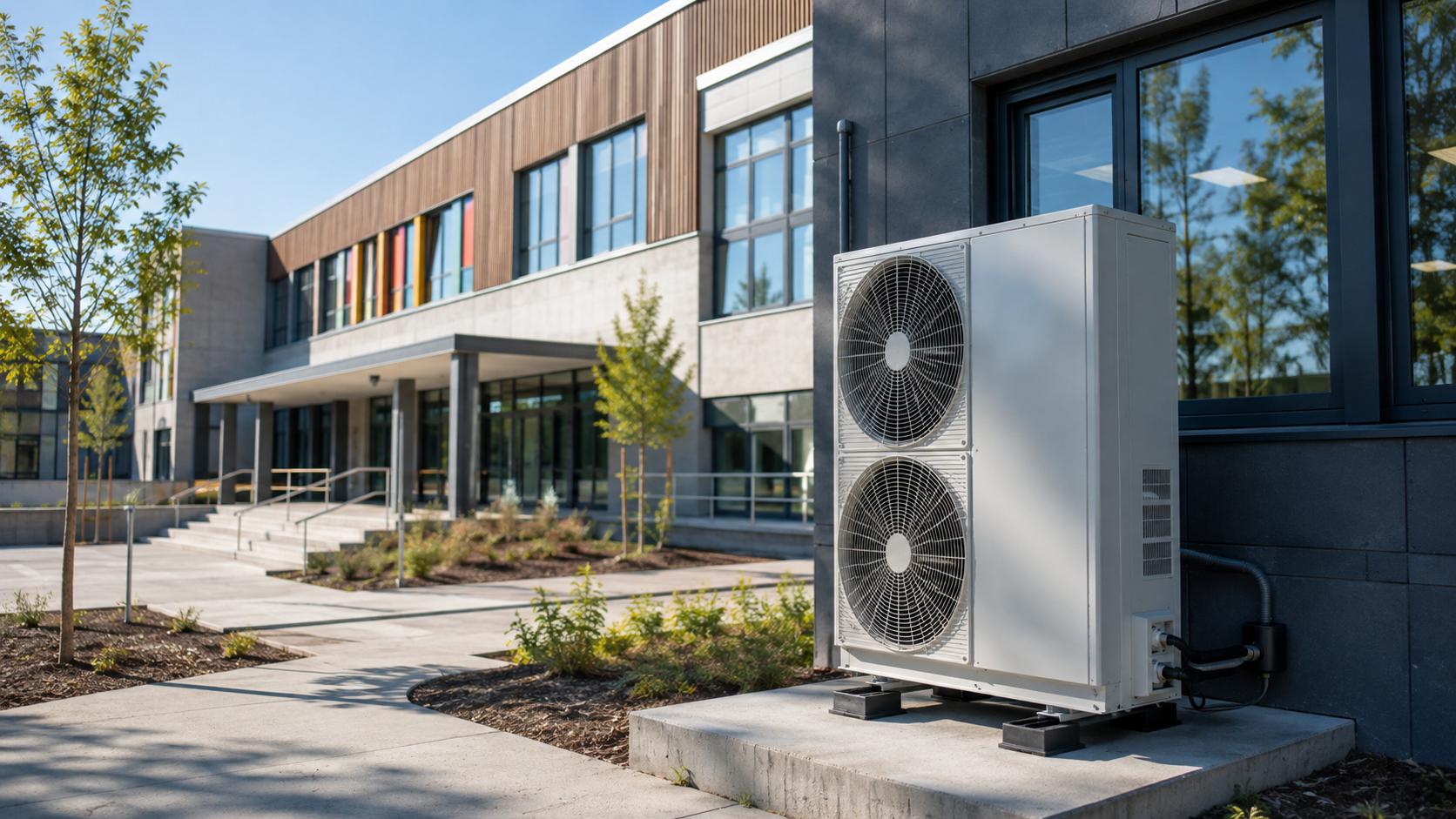
The decarbonisation of municipal facilities increasingly requires rethinking how public buildings are heated, cooled and ventilated. Renewable heating and cooling based on heat pump technology represents a key opportunity to reduce emissions, improve energy efficiency and ensure better levels of thermal comfort in a context of climate emergency and rising temperatures.
However, this transition should not be viewed as simply replacing a fossil fuel boiler with a heat pump. The electrification of thermal energy use must be approached as a strategic, progressive process tailored to the specific circumstances of each municipality and each building.
Today, municipalities face several challenges when it comes to heating and cooling their buildings:
Ageing equipment: Traditional heating systems are beginning to suffer recurrent failures or even face the risk of imminent breakdown. This makes it the right time to rethink heating and cooling systems and adapt them to users' needs, current regulations and the new climate reality.
Carbon dioxide emissions and other air pollutants: Boilers fuelled by fossil fuels emit carbon dioxide (CO₂) and other pollutants —NOx, PM10, PM2.5, O₃, SOx, CO, C₆H₆ and H₂S—, moving municipalities further away from their climate neutrality targets while worsening air quality.
Lack of thermal comfort and adaptation to climate change: Thermal comfort refers to a person's satisfaction with the indoor environment. This perception depends on factors such as metabolism, temperature, humidity, clothing and physical activity. Incorporating cooling systems into buildings improves thermal comfort during the summer months, unlike traditional fossil fuel-based systems, which typically provide heating only.
Poor indoor air quality: Ventilation in heavily used buildings is often inadequate when carried out manually by opening doors and windows. When redesigning heating and cooling systems, it is also advisable to assess the condition of indoor emitters and consider installing mechanical ventilation with heat recovery. This helps improve both the building's energy performance and the indoor air quality experienced by its occupants.
To support this transition towards efficient, renewable heating and cooling, the electrification of thermal energy use is proposed as a strategic and iterative process. The proposed pathway begins with an inventory of existing thermal systems and continues through building prioritisation, energy analysis, roadmap development, assessment of the urban context, preparation of the detailed engineering design, financing, implementation and, finally, verification of the results achieved.
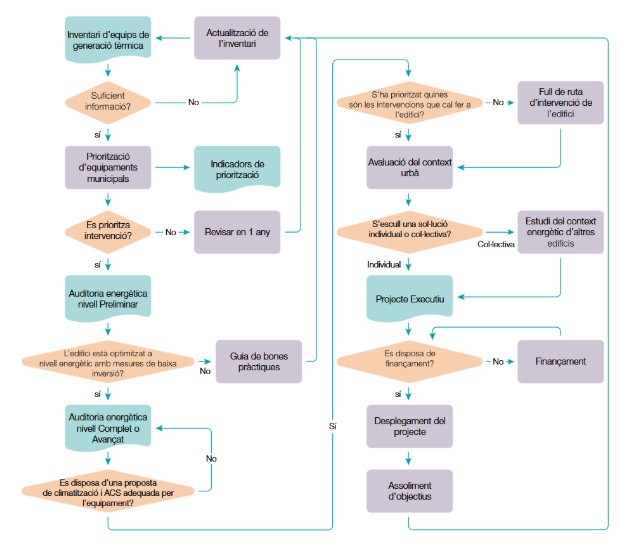 The first step is to gain a thorough understanding of the starting point. This involves compiling an inventory of the municipality's thermal energy systems and collecting data such as energy consumption, service life, installed capacity, performance, operating costs, emissions, usage patterns, available control systems, terminal units and installation constraints. Based on this information, buildings can then be prioritised according to their potential impact, taking economic, environmental, social and urgency criteria into account.
Once a building has been prioritised, it is essential to look beyond the plant room and understand the overall performance of the building. To achieve this, different levels of energy audit are proposed, ranging from a preliminary assessment to identify simple, low-cost measures, to more comprehensive audits using energy modelling to compare different scenarios and determine the most appropriate solution. The objective is not simply to replace existing equipment, but to identify the best combination of building refurbishment, ventilation, terminal units and heat pump technology for each specific case.
Within this roadmap, directly replacing a fossil fuel boiler with a heat pump may provide a quick solution, but it is not always the most efficient one, particularly if the existing heat emitters require high operating temperatures. An alternative pathway is therefore proposed, including the installation of mechanical ventilation, using ventilation systems to provide heating and cooling, combining existing terminal units with new equipment, or improving the building envelope to reduce energy demand and enhance the overall performance of the system.
At this stage, the urban context of the building also needs to be assessed. Consideration should be given to whether an individual solution for the building is most appropriate, or whether a shared solution involving neighbouring buildings would be more effective. The most suitable type of heat pump must also be selected. Ground-source and water-source heat pumps can deliver higher efficiencies because they rely on more stable thermal sources, although they require additional space and infrastructure, making them particularly well suited to collective solutions such as district heating and cooling networks. By contrast, for stand-alone buildings or sites with limited space, individual air-source heat pumps are generally the most practical option.
The chosen approach should then be translated into a detailed engineering design that clearly justifies all technical decisions. It is also advisable to prepare a financial plan to support project delivery through a combination of own resources, public grants, savings monetisation or energy performance contracts with energy service companies (ESCOs).
Finally, successful implementation and performance verification are essential. This requires a well-defined procurement process, coordinated installation works, thorough commissioning and ongoing monitoring based on indicators such as electricity consumption, useful thermal energy delivered, emissions, operating costs, seasonal performance, system faults and indoor thermal comfort. Only in this way can the planned decarbonisation deliver better public services, lower emissions and more efficient operation of municipal buildings.
All these criteria, stages and recommendations are explained in greater detail in the Guide to the Electrification of Thermal Energy Use in Municipal Buildings, published in 2026 as a new reference document supporting the decarbonisation of public buildings. The Guide was prepared on behalf of the Xarxa de Ciutats i Pobles Cap a la Sostenibilitat by the technical team from the Climate Action and Energy Transition Department of the Barcelona Provincial Council together with SUNO Enginyeria de Serveis Energètics, SCCLP.
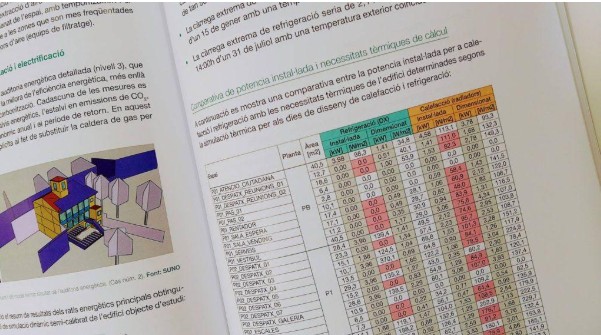 Guide to the Electrification of Thermal Energy Use in Municipal Buildings
Link to the Guide presentation and dissemination event
Toni Cantero and Jesús Teixidor, industrial engineers and partners at SUNO Enginyeria de Serveis Energètics.



_20231114162600.png)

