
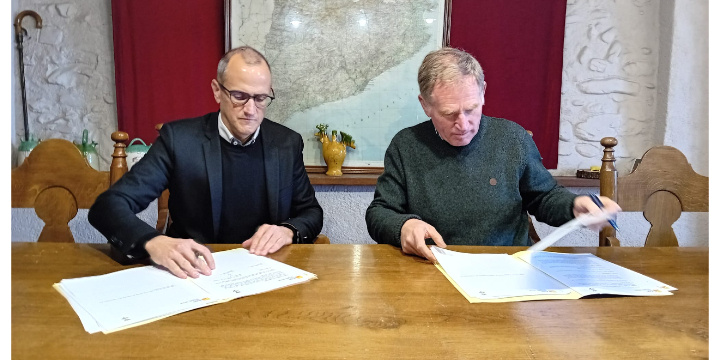
The Department of Territory, Housing and Ecological Transition of the Generalitat de Catalunya has reported in a press release that the Cartographic and Geological Institute of Catalonia (ICGC) will begin this spring to study the potential of deep geothermal energy of the subsoil of Cànoves and Samalús, mainly from thermal waters.
On February 26, the director of the ICGC, Antonio Magariños, and the mayor of the municipality, Josep Cuch, signed an agreement that will carry out a survey of geological prospecting at 550 meters deep in the nucleus of Samalús to characterize the existing rocks and obtain data from the subsoil that allow to advance in the use of geothermal as an energy resource.
Geothermal is a renewable, clean, sustainable, autochthonous and zero kilometer source of energy that takes advantage of the heat of the subsoil to provide hot water for multiple thermal uses and even for the generation of electricity. Depending on the temperature at which this heat is used, it is possible to distinguish between geothermal of superficial origin and deep origin.
In surface geothermal, a temperature of the subsoil is used, usually between 16 and 25 degrees Celsius and on average at 100 meters deep, which does not change either in winter or summer. This stability is used to power air conditioning systems for individual buildings and urban heating and cooling networks, but a heat pump mechanism must be used to increase or lower the temperature. This type of geothermal can be implemented almost throughout Catalonia, both in residential buildings and in the tertiary sector, and is the most efficient thermal technology of all.
The Network of Geothermal Stations of Catalonia (XEGCat) of the ICGC includes several prospecting points at shallow depth (up to 100 meters) and in urban areas. The last monitored points that were incorporated are located in Vielha.
Deep geothermal and thermal source
In contrast, deep geothermal origin is much deeper and the temperature can be between 30 and more than 150 degrees Celsius, which facilitates its use without the need for heat pumps. The uses of this energy vary according to the temperature, but they can go both for heating and cooling networks, food production (to heat greenhouses, for example), industrial uses and even, if they exceed 100 degrees, to generate electricity. Around Catalonia, if drilled to the appropriate depth, this type of resource is always found. The ICGC has it catalogued in Geothermal Resources of Deep Origin in Catalonia (RGOPCat): synthesis of its potential.
This is the case of Cànoves and Samalús, where a prospection will be made next to the football field of the Xavier Flaquer i Juvany Civic Center in the nucleus of Samalús, on municipal land, and at a depth of up to 550 meters. The ICGC has just tendered the works with the forecast to start the prospections this spring. Once executed, the installation will be integrated into the environment.
The chosen place, in addition to not being located in an urban area, responds to a peculiar and still little studied characteristic: the presence of thermal waters. These waters constitute a direct manifestation of heat from the deep subsoil, which rises to surface levels through the circulation of groundwater through more permeable layers. This type of geothermal energy, still little used in Catalonia, has traditionally been used for recreational and medicinal uses in spas, although it offers a wide variety of other possibilities of application.
It has the advantage that, to take advantage of it, it is not necessary to drill as deep as in other parts of the territory to reach the same temperature of the deep geothermal resource. That is why the area of Samalús that will be studied is included in the catalog of areas with deep geothermal potential of Catalonia prepared by the ICGC.
In fact, in the area, associated with the Vallés fault, surveys were carried out in the 80s and 90s of the last century, the deepest of which reached 1,000 meters deep, but no complete records are preserved. Historical data suggest that the new prospection could confirm temperatures between 60 and 90 'C at 550 meters depth, potentially suitable for various thermal uses.
In addition, in the Vallès basin but at depths of between 2,000 and 3,000 meters, temperatures could be reached that, if confirmed in future research phases, would allow the use of this deep geothermal energy also for the generation of electricity.
A decarbonized energy model
In a context of transformation towards a decarbonized energy model, prospecting in Caroves and Samalús reinforces the Government's commitment to consolidate geothermal energy as a strategic, stable and potential renewable energy source.
The new prospection will be integrated into the Network of Geothermal Stations of Catalonia (XEGCat) as a new permanent monitoring point. The survey is carried out in an area where there is a hydrothermal anomaly identified years ago as a geothermal resource of deep origin, currently included in the catalog of geothermal areas of interest of Catalonia prepared by the ICGC.
The infrastructure will generate reference data and a solid technical basis to evaluate, with criteria of rigor and security, the development of geothermal projects both locally and in other areas with similar characteristics. This knowledge can facilitate, in the medium and long term, the maturation of investment projects and public-private collaboration linked to the use of geoenergy.
The project is also part of the European Horizon Europe Go-Forward program, which develops advanced methodologies to improve the location and prediction of the productivity of deep geothermal reservoirs, with the participation of several European partners.


_20231114162600.png)

