
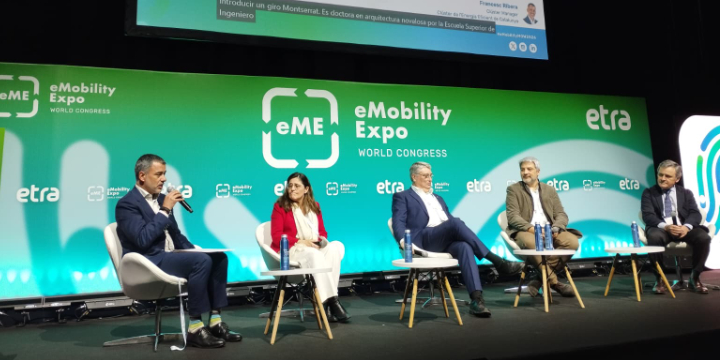
The Clúster de l’Energia Eficient de Catalunya participated this week, on 10 and 11 March, in the eMobility Expo World Congress de Màlaga, held in Málaga and organized by Nebext. The event has established itself as a key meeting point for professionals in sustainable, electric, safe, and connected mobility.
The CEEC’s participation in the congress enabled it to contribute to the debate on the main challenges and opportunities in the sector, in a context where the transition to a zero-emission mobility model is becoming increasingly urgent.
During the congress, Cluster members took part in several round tables to provide their strategic perspective on the sector’s evolution. In the session “Competing Models in Battery Recycling: Incumbents, Disruptors and New Industrial Players”, Laia Balagué, CEEC Project Manager, moderated the discussion on the challenges of the circular economy and the different approaches to battery recycling, as well as the role of established companies in the face of emerging disruptive solutions.
Meanwhile, CEEC Cluster Manager Francesc Ribera, moderated the round table “The Future Energy Mix: Batteries, Hydrogen and Hybrid Systems for Mobility & Industry", focused on how the coexistence of different technologies —such as batteries, hydrogen, and hybrid systems— will play a key role in decarbonising mobility and industrial activity. Dani Pérez (KM0 energy), coordinator of the Electromobility Working Group, also participated as a speaker.
Driving technological innovation in electric mobility
The congress also included contributions from other CEEC members. Alejandro Valdovinos (CIRCONTROL), a member of the Board of Directors, spoke at the session “Supercharging the Automotive Sector”, analysing the role of ultra-fast charging in the development and integration of electric vehicles.
Ramon Gallart (Estabanell), also a Board member, participated in the round table “Energy resilience in Europe: how future power grids will secure a stable, electrified and decarbonised economy", dedicated to analysing the transformation of the European energy system and the challenges related to grid resilience.
We reaffirm our commitment to promoting technological innovation, the circular economy, and digitalisation as key drivers of the new sustainable mobility.
The congress also served as a platform to explore key issues for consolidating electric vehicles, including:
The future energy mix and strategies for the massive and efficient integration of renewable energy.
Challenges related to the resilience, flexibility, and stability of the electricity grid in response to new consumption patterns.
Accelerating the deployment of an intelligent, accessible, and robust charging infrastructure, essential to building user confidence.
These discussions highlight the importance of working in networks, sharing knowledge, and driving technological innovation in electric mobility to achieve an effective energy transition.

_20231114162600.png)

